
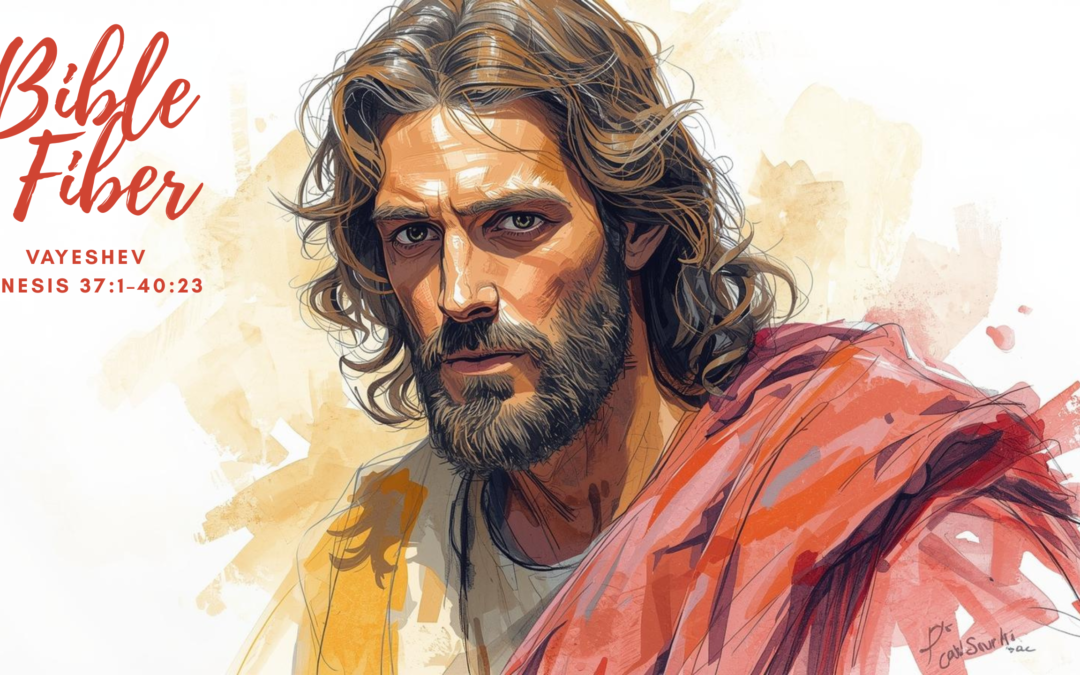
Bible Fiber is taking a one-year sprint through the foundational narratives of the first five books of the Bible, the Torah. As we follow the weekly Jewish reading calendar, we arrive at this week’s Torah portion, called Vayeshev, which covers Genesis 37:1–40:23. Once Jacob and his family settle into the land promised to his father Abraham, the narrative moves to the dynamics between his many children. At first, the story feels consistent with the biblical theme of sibling rivalry. Cain and Abel, Isaac and Ishmael, Jacob and Esau, and now Joseph versus his brothers.
Subscribe to Bible Fiber on Youtube or Follow Bible Fiber wherever you listen to your podcasts!
Except, Joseph’s life story is one of the most masterful literary arcs in the whole of scripture. It goes far beyond just an example of brotherly jealous provoked by parental favoritism. The complex characters are fully developed so that no one is entirely guilty or innocent. The setting changes from pit to palace to prison as the storyline progresses. Although God does not make a dramatic appearance to Joseph, like the burning bush or a wrestling angel, he speaks to him in dreams, both his own and others. The entire time a tension hangs over the story asking the reader to discern between human agency and divine providence.
The Coat and the Crisis of Favoritism
Joseph was seventeen years old, a young man straddling the line between adolescence and adulthood, when his father Jacob gave him an ornate, long-sleeved tunic. Joseph and Benjamin were the sons of Jacob’s favorite wife, Rachel, and it seems Jacob made no effort to hide his preference. The gift immediately caught the negative attention of his brothers, but it’s important to realize that the garment was not merely an expensive gift. Such a tunic was a status symbol implying that Joseph was exempt from the same hard labor of the field as his brothers. Scripture records that when they saw this favoritism, “they hated him and could not speak peaceably to him” (Gen. 37:4).
Into this fractured dynamic, Joseph fanned the flame when he revealed to his brothers two of his recent dreams. The first dream involved sheaves of grain in the field with each sheaf representing one of Jacob’s sons. Joseph described their sheaves bowing to his sheaf (Gen. 37:7). In the second dream, the brothers were eleven stars, and they all bowed to Joseph’s star (Gen. 37:9).
Though Joseph’s symbolic dreams later come true, he shows the naivety of a 17-year-old by sharing them with his already jealous brothers. They were within their rights to resent Joseph for the coat alone, but the dreams brought his offense over the top.
Joseph follows his brothers to Dothan, and the text shifts to their perspective. “They said to one another, ‘Here comes this dreamer’” (Gen. 37:19). The plan to kill him evolves rapidly, tempered only by Reuben’s intervention.
Reuben, as the oldest son of Jacob, refused to participate in his brothers’ murderous plan because of his responsibility as the firstborn. His intervention was a measured, strategic move intended to save Joseph while appearing to appease his angry siblings. He suggested they avoid shedding blood and instead throw Joseph into an empty cistern in the wilderness. This was not the end goal; his secret intent was to return later, after his brothers had departed, and rescue Joseph to restore him safely to their father, Jacob. Tragically, while Reuben was away, Judah persuaded the brothers to sell Joseph to a passing caravan of Ishmaelite traders.
The appearance of the caravan adds a layer of bitter irony to the family drama. The text identifies the traders as Ishmaelites and Midianites. Both groups were descendants of Abraham through Hagar and Keturah—who had been cast out of the family generations earlier to secure Isaac’s place. Now, in a twisted reversal of fortune, the descendants of the rejected sons return to carry off the chosen line into exile.
Joseph is sold for twenty pieces of silver, the price of a slave. For Christian readers, this moment creates a haunting echo of a future betrayal when Judas sells Jesus for thirty pieces of silver. In both instances, the beloved son is handed over by his own people to a suffering that ultimately leads to salvation.
The brothers then dip Joseph’s tunic in goat’s blood. When the bloodied coat is presented to Jacob, he identifies it immediately: “It is my son’s tunic. A wild beast has devoured him” (Gen. 37:33). Jacob descends into a mourning that refuses comfort.
The Descent into Egypt and the Test of Character
When Joseph arrives to Egypt, he is purchased by Potiphar, the captain of Pharaoh’s guard. Here, the text introduces the refrain that defines Joseph’s exile: “The Lord was with Joseph, and he became a successful man” (Genesis 39:2). Joseph will come of age as a stranger in a strange land, not defined by his family but instead by his relationship with his Creator.
Joseph’s rise in Potiphar’s house is meteoric. He becomes the overseer, managing everything his master owns. This success, however, sets the stage for his greatest moral test. Potiphar’s wife casts her eyes on Joseph, who the text notes was “handsome in form and appearance” (Gen. 39:6). Her solicitation is blunt and repeated.
Joseph’s refuses her advances not because he lives in fear of punishment. Instead, he cites three reasons: the betrayal of his master’s trust, the violation of moral order, and ultimately, the sin against God. He asked, “How then can I do this great wickedness and sin against God?” (Gen. 39:9).
When she physically grabbed his garment, saying “Lie with me” (Gen. 39:12), Joseph fled, leaving the tunic in her hand. This is the second time Joseph is stripped of his garment, and the parallel is devastating. The first time, his brothers took his coat of many colors—the sign of his father’s love—to fake his death. Now, Potiphar’s wife uses his garment—the sign of his master’s trust—to frame him for a crime he did not commit. In both instances, the physical symbol of his chosen status is stripped from his body and weaponized.
The Prison and the Interpreter
Potiphar’s anger lands Joseph in the royal prison. Yet, even here, the “hidden hand” of God is at work. Joseph rises to leadership within the prison and encounters the cupbearer and the baker. The cupbearer dreamed of a vine with three branches that bore ripe grapes, which Joseph interpreted to mean that in three days he would be restored to his position serving Pharaoh. Conversely, the baker dreamed of three baskets of bread on his head being eaten by birds, which Joseph grimly interpreted to mean that in three days he would be executed.
When he interprets their dreams, he has matured; he no longer centers the dream on himself as he did at seventeen, but explicitly credits God with the interpretation. He predicts the cupbearer’s restoration and asks only to be remembered. The parsha ends with a crushing silence: the cupbearer is restored but “did not remember Joseph.”
This Torah portion, Vayeshev, presents a Joseph who is acted upon more than he acts. He is sent by his father, seized by his brothers, sold by traders, bought by Potiphar, assaulted by Potiphar’s wife, and forgotten by the cupbearer. Yet, through this cascade of victimhood, Joseph’s character solidifies. He is being stripped of every reliance on human structures—family, employer, political allies—so that he can emerge as a leader who relies solely on God. The “pit” is not just a place of suffering; it is a womb of transformation. The story leaves us in the dark of the dungeon, waiting for the light of the next part of the story, reminding the reader that even when God seems silent, he is often doing his most critical work.
A modern Joseph story
The power of Joseph’s narrative to sustain the human spirit in the darkest of pits is not merely ancient history; it recently became a lifeline for a modern captive. Segev Kalfon, a young Israeli taken hostage from the Nova music festival, shared a moving testimony about finding hope through the story of Joseph while held in Gaza. During his 738 days in captivity, his captors occasionally allowed him to watch television, and he happened to see an animated series depicting the life of Joseph. Watching the biblical character thrown into a pit and imprisoned resonated with his own situation; he realized that just as Joseph endured the darkness of the dungeon before being raised up, he too could survive his captivity.
In a striking parallel, Segev later learned that at the very time he was watching the show in Gaza, his father in Israel had turned to the biblical text of the Joseph story for comfort, hoping for his son’s return. Segev’s experience, which concluded with his release in October 2025, serves as a modern affirmation of the Genesis’s central message: God is with us.
That’s it for this week. In the newsletter version of the episode, I am including three questions that you can study for either your personal use or a group study. They are thought-provoking questions that I think the text asks of us as readers. Be sure to sign up for our emails at www.thejerusalemconnection.us.
Join me next week as we read Miketz, which covers Genesis 41:1–44:17.
Shabbat Shalom and Am Israel Chai.
Questions
- Covenant Anxiety (Genesis 37:11 & 37:20): The brothers’ hatred toward Joseph was likely fueled by a fear of being “left out” of the covenant, just as Ishmael and Esau were excluded in previous generations. They attempt to kill the dreamer to kill the dream, believing they must fight for their place in the family line. How does our own insecurity about our status or calling often drive us to act destructively toward others, and how does the brothers’ error warn us against trying to force God’s hand?
- The Theology of Integrity (Genesis 39:9): When tempted by Potiphar’s wife, Joseph refuses on the grounds that it would be a “great wickedness and sin against God.” He does not mention the fear of getting caught or the social consequences, but rather identifies the sin as a direct offense against his Creator. How does viewing private moral failures as a breach of relationship with God—rather than just a violation of rules—change the way we approach temptation in our own lives?
- The Discipline of Silence (Genesis 40:14 & 40:23): Joseph interprets the cupbearer’s dream accurately and asks only to be remembered, yet the chapter ends with him being utterly forgotten in prison for two more years. It is during this time of silence that Joseph transforms from a naive dreamer into a mature leader. Why does God often use periods of waiting and apparent abandonment (”the pit”) to prepare us for leadership, and what can we learn about trusting God’s timing when we feel forgotten by people?